

2026 Mood: Stitches Through Time
This year, the Great Tennessee Yarn Tour is taking a journey to knit, crocheted, and woven fabrics throughout the ages. For Pattern Contest designs, we would like to see a modern twist on historical favorites - or perhaps some historical flair added to a modern fave! Use this Mood Board to get your creative juices going, and let yourself be inspired by vintage designs and trends!
Please Note: Although many of the pictures below are of sweaters and cardigans, we don't expect designers to stick only those project types pictured - let these photos inspire your own vintage pattern design!
1800's
For the 1800s, think about garments and accessories with minimal shaping and simple construction. Patterns focused heavily on lace, decorative edgings and trims that dressed up more simple construction techniques. Weaving patterns of the 1800s featured popular coverlets with intricate geometric designs like "Sun, Moon, and Stars," "Whig Rose," and "Snowball," often in blue/white or natural colors, using techniques like overshot and double-cloth, while the decade also saw the rise of the automated Jacquard loom, enabling complex patterns and inspiring early computing, moving from hand-spun to machine-spun fibers, and evolving towards simpler Victorian styles by the century's end.


1920's - The "Flapper Era;" music, dancing, freedom, women's right to vote
Knitting and crochet patterns in the 1920s reflected the era's shift toward "the New Woman," favoring tubular silhouettes, sporty attire, and Art Deco geometric designs. As the "Flapper" style took hold, traditional lace gave way to sleek silk jumpers and functional sports sweaters.
Popular Garments and Styles:
-
Jumpers and Sweaters: The 1920s popularized the "jumper-tabard," often featuring a straight, drop-waist fit. Common styles included V-neck sports sweaters and "Eton collar" jumpers.
-
Accessories: The Cloche Hat was the quintessential headwear of the decade, often knitted with asymmetrical brims or decorative roses. Other popular items included "Flapper bags," beaded evening scarves, and knitted silk lingerie.
-
Sports & College Wear: With the rise of college sports, color-blocked sweaters
1920s weaving patterns featured bold Art Deco geometrics (chevrons, zigzags, sunbursts), stylized florals, and metallic threads, often on simpler structures like plain weaves or reps for everyday fabrics.


1930's - The "Depression years;" inspiration from Hollywood and movie stars
Knitting patterns from the 1930s reflect the elegant, form-fitting "Art Deco" silhouette of the era, moving away from the loose, shapeless styles of the 1920s. Patterns from this decade often feature intricate stitch work, puff sleeves, and tailored details like collars and belts. In the 1930s, weaving patterns and textile designs were heavily influenced by the economic constraints of the Great Depression, leading to a resurgence in resourceful hand-weaving and the use of vibrant, small-scale prints to boost morale. Beads, sequins and embroidery was often used to decorate simpler items.
Popular Garments and Styles:
-
Women's Fashion: Common patterns included lace jumpers with bow necklines, puffed-sleeve blouses, and two-piece knit suits featuring matching skirts and cardigans.
-
Evening Wear: Unique to this era were floor-length lace evening gowns, often with open backs or dramatic deco-style sunburst patterns.
-
Accessories: Popular patterns featured crocheted berets, turban-style hats, lace collars, and even knitted belts.
-
Menswear: Patterns focused on textured waistcoats, Fair Isle pullovers, and sportswear like golf socks or "cycling jerkins"


1940's - During WW2, styles and designs more utilitarian, but still with bright colors
Patterns from the 1940s are defined by wartime utility, the "Make Do and Mend" ethos, and a silhouette featuring padded shoulders and nipped-in waists. Because yarn was rationed, patterns often utilized "thrifty" stitches like lace or texture to stretch limited supplies.
Popular Garments and Styles:
-
Victory Jumpers: Patriotic-themed sweaters, often featuring lace or simple two-row patterns for quick construction.
-
Military Essentials: Patterns for "the forces," including balaclavas with ear flaps for telephone use, fatigue caps that double as scarves, and rugged mittens.
-
Feminine Separates: Slim-fitting cardigans, twinsets, boleros, and "bed jackets" for warmth in drafty homes.
-
Headwear: Turbans in moss-stitch or stocking-stitch, snoods, and "pixie hoods".
-
Accessories: Fishnet stockings, "Miss Marple" bow scarves, and Fair Isle gloves.


1950's - Post-war - the "New Look" - Fitted bodices and full skirts gave way to the sheath dress, straight skirts with boxy jackets.
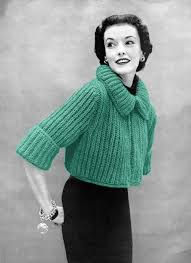
Patterns from the 1950s are defined by their tailored, body-hugging silhouettes and elegant detailing, reflecting the "New Look" era of post-war fashion. These patterns prioritized structure and femininity, often featuring cropped lengths designed to sit at the natural waist. In the 1950s, weaving was characterized by a shift toward abstraction and the use of vibrant colors, reflecting the broader modernist trends of the decade.
Popular Garments and Styles:
-
The Twin-Set: The quintessential 1950s ensemble, consisting of a short-sleeved jumper or under-sweater worn beneath a matching long-sleeved cardigan. It was typically accessorized with a string of pearls for a classic finish.
-
Cropped Sweaters and Boleros: Short-waisted designs were popular for pairing with high-waisted skirts or trousers. Styles included short-sleeved cardigans with collars and 3/4 sleeve bolero jackets.
-
Novelty Knits: Mid-century patterns often featured playful, non-realistic motifs, such as the famous Mary Maxim "Cowboy" or "Ranch wear" cardigans and "Zodiac" jumpers.
-
Lace and Open-Work: Lacy spring sweaters and blouses with scoop or boat necks often featured intricate yoke designs and airy stitch patterns.


1960's - The age of the mini skirt and the maxi skirt, boots, and bright colors
1960s patterns are defined by the "Mod" aesthetic, transitioning from the structured styles of the 1950s to bold, geometric, and experimental designs. Key trends included mini-dresses, shift silhouettes, and vibrant color palettes influenced by Op Art and pop culture.
Popular Garments and Styles:
-
Mod Shift & Mini Dresses: Short, sleeveless, or bell-sleeved dresses in a straight "sheath" or slightly flared "A-line" silhouette were iconic.
-
Geometric & Op Art Prints: Designers used contrasting colors to create visual illusions, often featuring chevrons, checkerboards, circles, and bold stripes.
-
Boho Vests: Toward the late 60s, fringed and floral "hippie" vests became a staple accessory.
-
Ponchos & Shawls: Fringed ponchos and peasant-style shawls with ripple or diamond patterns were widely worn.


1970's - The hippie look was popular with handmade clothes, accessories and décor. Lots of embroidery, beading and color.
The 1970s saw a renewed interest in handmade knitwear using natural fibers, resulting in vibrant, free-spirited designs. Popular projects included everything from long vests and ponchos to sweater dresses, bellbottoms, and tiny halter tops, often in earthy tones like mustard, plum, and olive green, or bright, psychedelic colors.
1970s weaving patterns focused on earthy tones, natural textures, bold geometrics, and organic/bohemian themes, popular in wall hangings, rugs, and clothing, utilizing techniques like flatloom weaving, macramé, and punch needle, often featuring chunky yarns, fringe, and designs like sunbursts, forests, and abstract shapes. Common projects included large wall tapestries, afghans, and even decorative items like tissue box covers, reflecting the era's DIY craft boom


